

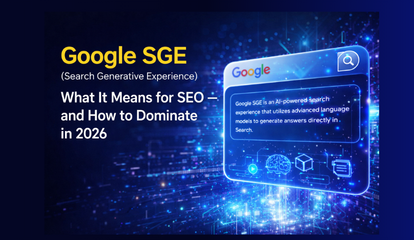
Google Search has changed more in the last 18 months than in the previous decade. Google is no longer just ranking pages — it’s deciding which content deserves to be the answer. If your business depends on organic search for leads, you need to understand what SGE is, how it works, and specifically what it means for your content strategy.
What is Google SGE? (SGE Full Form in SEO)
SGE stands for Search Generative Experience. It’s Google’s AI-powered system that generates direct answers on the search results page, pulling from multiple sources rather than just listing links. Users get a synthesized response upfront, and only scroll to individual websites if they want more depth.
The practical effect: informational queries now get answered without a single click. That’s not a minor update — it’s a structural shift in how traffic flows.
What SGE Means for SEO (The Real Impact)
The old model was straightforward: rank on page one, get traffic. The new model works differently. Google’s AI evaluates your content for authority, structure, and relevance to the query — then decides whether to surface it inside the generated answer.
Content that’s generic, poorly structured, or thin on expertise won’t appear in SGE results at all. It’s not that it ranks lower. It’s that it becomes invisible to a large share of queries.
What this means in practice: informational traffic drops for most sites, but the traffic that does convert is higher quality. Low-intent visitors who just needed a quick answer never click through. The ones who do are already 60% of the way to a buying decision.
SGE in Digital Marketing: What You’re Actually Losing (and Gaining)
Most agencies are telling clients that SGE is something to “prepare for.” It’s already here.
The traffic losses are concentrated in informational queries — “what is,” “how does,” “difference between.” These were never converting well anyway. The real risk is if your transactional pages — service pages, location pages, pricing pages — aren’t built with enough topical authority to support them.
What you gain, if you play this right, is better qualified traffic, stronger brand trust from being cited in AI answers, and a competitive gap between you and agencies still writing 500-word blogs around single keywords.
GEO and AEO: The Next Layer After SGE
Two terms worth knowing:
GEO (Generative Engine Optimization) is the emerging discipline of optimizing content to be selected by AI-driven engines, not just ranked by traditional algorithms. Where SEO asks “does this page rank,” GEO asks “does this content get cited.”
AEO (Answer Engine Optimization) focuses specifically on structuring content so that AI systems can extract and display it as a direct answer. Clear definitions, structured headings, short factual paragraphs — these are AEO fundamentals.
Both concepts are extensions of SEO, not replacements. The underlying goal — making your content the most authoritative, useful answer to a query — hasn’t changed. The technical execution has.
How to Optimize for SGE (What Actually Works)
The single most important change is writing answer-first. Instead of building toward your main point, state it in the first two lines after each heading. Google’s extraction algorithm pulls the earliest, clearest response to the implicit question behind each section.
Beyond that, the factors that determine whether content appears in SGE results are the same ones that have always separated strong SEO from weak SEO: topical depth, internal linking that demonstrates expertise across a subject area, external signals that establish authority, and content that answers the real question rather than the keyword.
The practical checklist:
Write H2s that match exactly how users phrase questions. Follow each H2 with a direct, 2–3 sentence answer before expanding. Use short paragraphs. Build topic clusters so individual pages are backed by a broader content architecture. Avoid generic intros that delay the actual answer.
SGE in SEO: What Separates Content That Gets Featured
The clearest pattern across SGE-featured content is specificity. Vague claims (“SGE will change everything”) get ignored. Specific, structured explanations (“SGE affects informational queries most — here’s why that shifts your conversion funnel”) get extracted.
A simple test: read your H2 and the first paragraph beneath it. If someone could find that exact answer on 40 other websites, Google has no reason to feature yours. If your angle, depth, or framing is distinctly useful, you have a chance.
The Competitive Reality in 2026
SGE does not reward more content. It rewards better content from sources with demonstrated authority. An agency that has one well-structured, deeply researched pillar on technical SEO will outperform one that has 30 thin blogs on adjacent topics.
This is the shakeout. Businesses that invested in topic authority over the last two years are now seeing disproportionate returns. Those that chased keyword volume are losing ground.
The path forward isn’t complicated: pick the 3–5 topics you want to own, build genuinely useful content on each, structure it for AI extraction, and support it with strong internal linking and clear service pages.
Ready to Build an SGE-Ready SEO Strategy?
Most businesses don’t know which of their pages are at risk from SGE or where their authority gaps are.
SEOFox.io runs structured content audits that map your current rankings against SGE exposure, identify which pages need restructuring, and build the topic architecture that positions you for visibility in AI-driven search.
Get a free growth audit — we’ll show you exactly where you’re losing ground and what it would take to recover it.
