

Most SaaS teams don’t have an SEO problem. They have a growth problem disguised as SEO.
You publish some blogs, see some traffic, maybe even rank for a few keywords. But conversion rates plateau. Your pipeline remains erratic and unpredictable. And all of a sudden, SEO seems like a long game filled with blind spots and no ROI.
Here’s the reality. SEO without a growth strategy is just content production.
This blog outlines what a genuine SEO growth strategy for SaaS looks like when it’s built intent on generating revenue, rather than just traffic. If you’re a founder or part of a B2B team who wants to make SEO a real acquisition channel, this post will show you what needs to change.
Why Most SaaS SEO Strategies Fail
What most SaaS teams miss is that ranking is not the goal. Revenue is.
I see “a ton of traffic, with no conversions” a lot. Why? Content is attracting the wrong audience. Informational queries are taking the throne and high-intent keywords are either neglected or poorly written. Another sin is intent mismatch. You can rank your blog really well, but if it doesn’t align with what the user wants, they read their generic solution, don’t click on your call to action, and leave.
Then there’s the lack of strategic direction. So many SaaS treat SEO like a checklist – pump out blogs, add some keywords, and wait for the results. There’s no clear line of sight between SEO and the business.
The real problem is that SEO is not integrated into the growth engine. It operates in isolation, disconnected from product, sales, and revenue goals.
What Is an Effective SEO Growth Strategy for SaaS
A true SEO growth strategy for a SaaS is not about getting more pages to rank. It’s about building a system that reliably attracts, converts, and nurtures high-intent users. You can think of this as a search-led growth strategy, versus a guess-led growth strategy. Instead of trying to figure out what your audience wants, you use search behaviour to optimise your entire acquisition funnel.
Starts with demand. What are your potential customers looking for, at each phase of their journey? From problem awareness, to exploring solutions, and finally choosing one? Then aligns your content, landing pages and product all to that demand. A good one does these three things well.
This is where most SaaS teams shift from random SEO efforts to a structured growth channel.
The Content-Led Growth Framework for SaaS
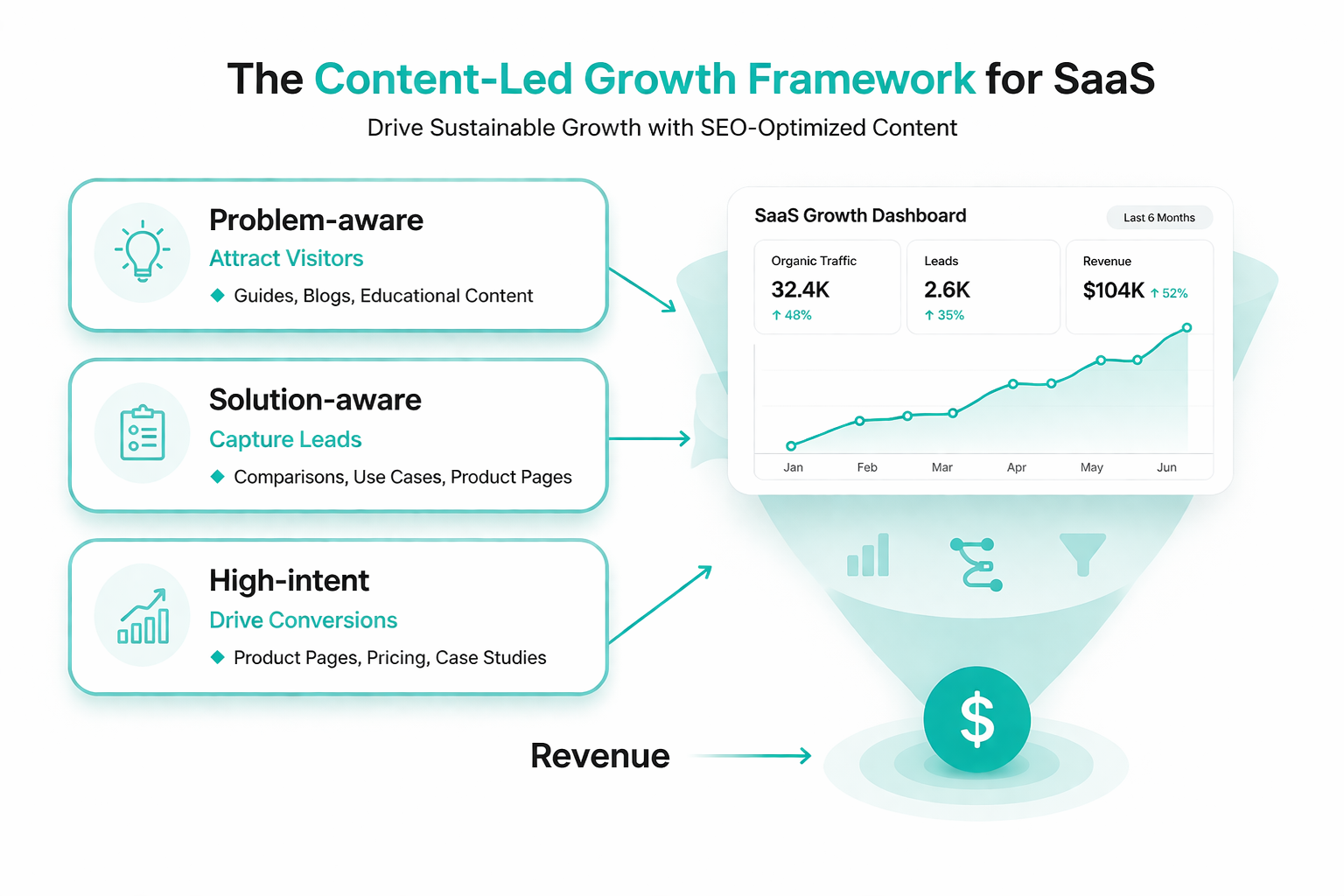
Content represents your central acquisition engine when used correctly. This content-led growth framework hones in on the critical link between content and the buyer journey. Not topic creation but a step-based system that gets users closer to conversion.
At the top you have problem-aware searches. Users are trying to diagnose their pain. Building trust and relevance is the name of the game. In the middle, you have solution-aware. Comparisons, use cases, alternatives. The intent is sharper here. Decisioning is happening.
Down at the bottom you build momentum, capitalizing on high-intent keywords, product-led pages, feature comparisons, commercial queries. Conversions happen here. The mistake that most teams make in building out SEO infrastructure is over-investing in top-of-funnel content. You get the traffic, but no revenue.
Balanced architecture supports every stage of the funnel. More importantly, it supports interconnected content. A blog post should lead to a use case page. A use case page should lead to a product page.
This is how content starts behaving like a sales system rather than a publishing exercise.
SEO KPIs for Business Growth, Not Vanity Metrics
Traffic is easy to measure. Revenue is harder. If you want to grow, you’ll want to track the right metrics. SEO KPIs for business growth lie in pipeline and revenue rather than visibility.
Begin with qualified organic traffic. You don’t want just any site visitor; you want the kind of visitor that ticks all your ideal boxes and shows search intent. After that, look at conversations from organic traffic. How many of those visitors become leads, or trials, or demos?
Pipeline contribution is another important one. How much of your sales pipeline is influenced by SEO? That’s where you start to see the legs. Lastly, revenue attribution. It doesn’t have to be perfect, but you need to know how much attribution SEO receives in revenue. Even if it’s directional that’s better than not at all.
Key SEO KPIs That Actually Drive Growth
| KPI | What It Measures | Why It Matters for SaaS |
| Qualified Organic Traffic | Visitors with buying intent | Filters out vanity traffic and focuses on real prospects |
| Conversion Rate | Visitors to leads or trials | Shows how well your content drives action |
| Pipeline Contribution | SEO-driven opportunities | Connects SEO with sales outcomes |
| Customer Acquisition Cost | Cost per acquired customer via SEO | Helps compare SEO with paid channels |
| Revenue Attribution | Revenue influenced by SEO | Proves ROI and long-term impact |
What most SaaS teams miss is connecting SEO performance to business outcomes. Without this connection, SEO always feels like a cost rather than an investment.
Building a Long-Term SEO Roadmap for SaaS
SEO isn’t a “set it and forget it”; it’s a “flip the oil lamps” kind of deal. Most successful, long-term SEO initiatives develop through three stages: The foundation stage is the phase where you fix the basics. Technical SEO, site structure, keyword mapping, core pages. Most people underestimate the foundations stage, but the rest of your SEO depends on how well you complete this phase.
Next is the growth phase. This is where content production ramps up. You establish topical authority, target high-intent keywords, and start seeing consistent traffic growth. Finally, the scale phase. At this point, SEO becomes a predictable channel. You optimize existing content, expand into new cluster areas, and refine conversion paths.
Predictability matters. SEO shouldn’t feel like a wild card. Get the roadmap right, you can forecast growth, set expectations, and deliver value aligned with business objectives. This is when an SEO growth strategy for SaaS transforms from a short-term experiment into a long-term asset.
How Strategic SEO Drives Predictable Revenue
When SEO is done right, it can be one of the most reliable growth channels for SaaS. Growth doesn’t stop when your spend doesn’t like paid ads, but rather compounds — every piece of content, every optimized page.
A well-executed search-led growth strategy brings users actively looking for solutions. Not cold leads. They have intent. Over time, that creates a flow of inbound leads. Sales cycles go smoother because users are educated. Trust is built prior to our first interaction.
This is how SEO shifts from a marketing channel to a revenue channel. The key benefit is consistency. Rather than relying on the peaks of campaigns, you’re investing in a system that delivers month after month.
Conclusion
Most SaaS companies don’t fail at SEO due to lack of effort. They fail because of lack of strategy. An effective SEO growth strategy for SaaS is about aligning search demand with business goals. It is about building a system that turns intent into revenue.
“Focus on the right framework, right KPIs, and a roadmap, and SEO becomes far less of a guessing game.” “The winner of SEO is not the company with the most content—the winner of SEO is the company building the smartest systems.”
And once that system is in place, growth is no longer a question of if. It becomes a matter of how fast you can scale it.
Ready to Turn Your Organic Search into a Real Growth Channel?
If your traffic is growing but your pipeline isn’t, the strategy needs a second look. SeoFox works exclusively with SaaS companies, B2B teams, startups, and enterprise businesses that want organic search built around revenue not vanity metrics. We’ll show you exactly where the gaps are, no fluff, no pressure.
Book a free audit call and get a clear picture of what’s actually holding your growth back.
📍 Address: Shop 17/S2, First Floor, Vedant Commercial Complex, Vartak Nagar, Thane West – 400606, India
📞 Phone: +91 87675 32568
📧 Email: contact@seofox.io
🕐 Hours: Monday – Sunday: 9:00 AM – 8:00 PM
FAQs
- What is an SEO growth strategy for SaaS?
What is an SEO growth strategy for SaaS? An seo growth strategy for SaaS is a structured approach where you capitalize on search demand to drive qualified traffic, conversions, and revenue, so that what you’re creating aligns with both traffic and your goals at the same time.
- When will I see results using SEO for SaaS?
SaaS SEO can see results in a short timeframe (3-6 months) and begin to see revenue impact on a consistent basis in 6-12 months (depending on competition and execution).
- What is a content-led growth framework?
A content-led growth framework is strategy that uses content as the primary engine of user acquisition, at various stages of the buyer journey to drive users toward conversion.
- Which SEO KPIs matter most for SaaS growth?
Kicking off with qualified organic traffic, linking that to conversion rate, pipeline contribution and revenue attribution.
- How does SEO drive revenue in SaaS?
Again, search gives you access to high-intent users, warms these fresh faces on your site with content, and converts them to leads/customers who become an always reliable source of incoming revenue.
- What is long term SEO roadmap?
Long term SEO roadmap is a phased rollout encompassing foundation, growth, and scaling. It helps SaaS players build predictable, compounding SEO results over time.

